IKING GROUP-INSULATION AND ACOUSTIC SOLUTION FOCUS
Generator enclosures are not simply boxes designed to contain equipment. They are engineered acoustic and thermal systems that must control noise, withstand heat, maintain airflow, and satisfy fire-safety requirements at the same time.
For diesel and gas generator sets, the acoustic challenge is particularly complex because the noise spectrum includes low-frequency combustion and engine vibration, mid-frequency mechanical noise, and higher-frequency cooling fan and airflow noise. A successful enclosure therefore depends on more than selecting a material with a high sound absorption rating.
The construction of the acoustic panel, the mineral wool thickness and density, the perforated inner liner, the steel outer skin, ventilation attenuators and the sealing of joints all influence the final acoustic performance.
Mineral wool is widely used as the sound-absorbing core in generator acoustic enclosures, containerised power modules, compressor housings and industrial equipment cabins because it combines sound absorption, non-combustibility and thermal stability in a single insulation material.
This guide explains how mineral wool works inside an acoustic enclosure, which specifications matter during procurement, and why material selection should be based on the complete panel construction rather than density alone.
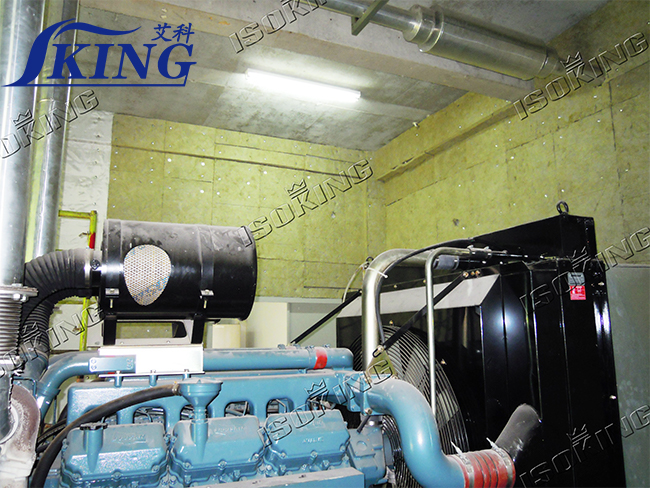
One of the most common misunderstandings in industrial acoustic design is treating sound absorption and sound insulation as the same thing.
They are not.
A steel enclosure wall primarily provides mass and sound transmission resistance, while mineral wool functions mainly as an absorptive layer. Its fibrous structure allows acoustic energy to enter the material, where frictional losses within the interconnected air and fibre structure convert part of the acoustic energy into small amounts of heat.
This makes mineral wool particularly useful for controlling reflected sound inside an enclosure.
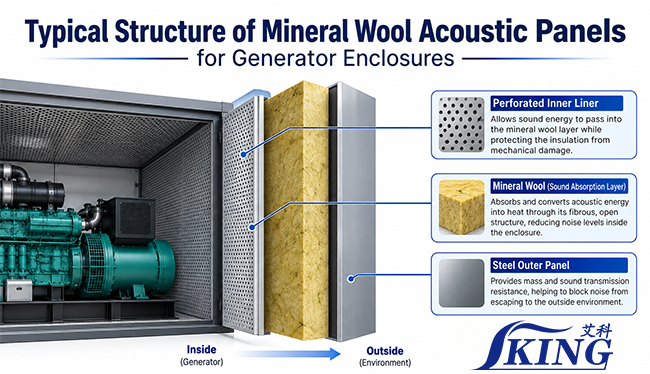
A typical acoustic panel may therefore use a construction similar to:
Generator → Perforated Inner Liner → Mineral Wool → Steel Panel → Outdoor Environment
The perforated inner liner allows sound energy to reach the mineral wool while protecting the insulation from mechanical damage.
The mineral wool absorbs acoustic energy inside the enclosure.
The outer steel layer provides mass and helps resist sound transmission.
This distinction is important because simply increasing the thickness or density of mineral wool does not automatically produce the same increase in overall enclosure sound reduction.
Generator noise is broadband rather than a single-frequency problem.
Diesel engines generate strong low- and mid-frequency components, while mechanical components, alternators, and cooling fans introduce additional frequencies.
Mineral wool provides broadband sound absorption and is therefore well suited to the absorptive layer of industrial acoustic panels.
For enclosure designers, however, the relevant question is not simply:
“What is the NRC of the mineral wool?”
A more useful question is:
“How does the complete panel assembly perform across the frequencies generated by the equipment?”
This is why frequency-dependent absorption data can be more informative than a single NRC value when designing critical generator enclosures.
Fire performance is one of the major reasons mineral wool is selected for power-generation applications.
Mineral wool products can achieve Euroclass A1 classification when the specific product and construction have been tested and certified accordingly under EN 13501-1.
This is particularly relevant around generator sets because an enclosure may contain an engine, fuel system, electrical equipment and hot exhaust components.
For data centres, hospitals, industrial plants and other critical infrastructure, material fire classification may be a project specification rather than simply an optional feature.
Procurement teams should therefore request the actual fire-classification documentation for the proposed product instead of relying only on the general term “fireproof mineral wool.”
Generator enclosures have a thermal-management problem as well as an acoustic problem.
Engine blocks, exhaust systems, silencers, and radiator discharge zones can create elevated temperatures inside the enclosure.
Mineral wool is an inorganic insulation material with strong resistance to elevated temperatures compared with many polymeric acoustic foams.
This makes it suitable for acoustic panel areas exposed to higher operating temperatures.
However, mineral wool should not be treated as a replacement for exhaust insulation or a properly engineered ventilation system. The insulation specification, exhaust system and airflow design must be considered together.
There is no universal mineral wool density that is optimal for every acoustic enclosure.
Depending on the application, manufacturers may supply boards across a broad density range.
For example:
-Lower-density mineral wool can provide an efficient absorptive layer where weight is a major concern.
-Medium-density boards can provide a balance between acoustic absorption, dimensional stability and handling.
-Higher-density boards may be selected where mechanical robustness or specific panel-construction requirements justify them.
The key point is that density should not be used as a standalone indicator of acoustic performance.
Two mineral wool boards with the same density can exhibit different acoustic behaviour because of differences in fibre structure, thickness, binder content, airflow resistivity and facing construction.
A mineral wool board does not work in isolation.
The performance of a generator enclosure depends on the interaction between several components.
A typical acoustic wall may contain:
Perforated steel or aluminium inner liner
↓
Mineral wool acoustic absorption layer
↓
Optional barrier or membrane layer
↓
Steel or aluminium outer skin
The perforated inner liner is particularly important.
If the mineral wool is completely covered by an imperforate, acoustically reflective surface on the generator-facing side, sound energy has less direct access to the absorber.
A properly designed perforated facing allows acoustic energy to enter the absorptive layer while protecting the insulation.
For this reason, buyers should evaluate the complete acoustic sandwich panel assembly, not simply purchase mineral wool based on density and thickness.
This is one of the areas where many general insulation articles provide insufficient engineering information.
Generator noise is not uniformly distributed across the frequency spectrum.
Low-frequency engine noise has a much longer wavelength than high-frequency fan or mechanical noise.
This means that a thin layer of porous absorber cannot simply be expected to eliminate low-frequency noise.
A practical enclosure therefore normally requires a combination of:
-Mass-loaded or high-mass barrier construction
-Mineral wool absorption
-Adequate panel thickness
-Air cavities where appropriate
-Vibration isolation
-Exhaust silencers
-Acoustic intake and discharge attenuators
-Properly sealed joints and penetrations
Mineral wool primarily addresses the absorptive component of the system.
It should not be marketed as a standalone “soundproofing” material capable of blocking every frequency generated by a generator.
This distinction is especially important for engineers specifying acoustic enclosures according to measured dB(A) targets.
Thickness is one of the most practical procurement decisions.
Common mineral wool thicknesses used in industrial acoustic panel construction include:
| Thickness | Typical consideration |
|---|---|
| 50 mm | Compact acoustic enclosures and space-constrained panels |
| 75 mm | Balance between acoustic depth and panel thickness |
| 100 mm | Higher absorption depth and more demanding enclosure applications |
| 100 mm+ | Large industrial enclosures where space permits |
Increasing thickness generally increases the effective absorption range of a porous absorber, particularly when the panel construction provides sufficient acoustic access to the material.
However, thicker insulation does not automatically translate into the same percentage reduction in overall dB(A).
The reason is that the weakest acoustic path may move elsewhere.
For example, if the wall panels are upgraded from 50 mm to 100 mm mineral wool but the enclosure still has poorly attenuated ventilation openings, unsealed doors or acoustic leakage around cable penetrations, the overall system improvement may be limited.
Generator enclosures cannot simply be sealed.
Combustion requires air, and the engine and radiator must reject significant quantities of heat.
This creates a fundamental engineering conflict:
The enclosure needs openings for airflow, but every opening can also become a path for noise transmission.
For this reason, generator acoustic systems commonly use:
-Acoustic intake louvers
-Discharge attenuators
-Baffle systems
-Acoustic ventilation ducts
-Exhaust silencers
-Sealed cable penetrations
-Acoustic doors with compression seals
A wall containing excellent mineral wool can still perform poorly if the ventilation opening becomes the dominant acoustic transmission path.
This is one of the most important concepts procurement teams should understand when comparing acoustic enclosure suppliers.
Modified ISO containers are widely used as generator housings because they provide a strong, transportable external structure.
However, the original steel container wall is not automatically an effective acoustic enclosure.
Bare steel surfaces can reflect sound energy inside the container and contribute to internal reverberation.
A typical containerised acoustic solution may therefore include mineral wool panels installed on:
-Side walls
-End walls
-Ceiling
-Access doors
-Service compartments
The ventilation system is then integrated with acoustic attenuators to maintain the required cooling airflow while reducing the direct transmission of engine and fan noise.
This makes mineral wool particularly relevant to modular power solutions where acoustic treatment must be integrated into a prefabricated enclosure.
Data centres create a particularly demanding application for generator acoustic systems.
Backup generators may need to operate close to office buildings, neighbouring properties and other critical infrastructure.
The enclosure may therefore need to address several requirements simultaneously:
Noise control + fire performance + thermal management + equipment access + weather resistance
Mineral wool is attractive in this environment because the same material can contribute to both acoustic absorption and thermal insulation.
However, data-centre projects should not specify the material using only generic terms such as “100 mm mineral wool.”
A professional specification should identify at least:
-Mineral wool type
-Nominal density
-Thickness
-Fire classification
-Acoustic test data
-Facing material
-Dimensional stability
-Moisture-related properties
-Temperature suitability
-Applicable test standards
-Batch consistency
-Available certification
This creates a much more reliable procurement specification.
Glass wool is also widely used for acoustic applications and can offer a lower-weight solution.
The choice between mineral wool and glass wool should be based on the required combination of:
-Acoustic absorption
-Fire classification
-Temperature exposure
-Density
-Panel construction
-Weight
-Cost
-Mechanical requirements
Neither material should be selected solely because one has a higher nominal density.
Polyurethane and melamine acoustic foams can provide effective sound absorption with low weight.
However, generator enclosures introduce additional fire and temperature considerations.
Where non-combustibility and high-temperature stability are major project requirements, mineral wool may offer a more suitable material platform.
The final selection should always be based on the tested product and the applicable project fire requirements.
Before placing a bulk order, procurement teams should request the following information from the manufacturer:
| Specification | Why It Matters |
|---|---|
| Thickness | Determines absorber depth and panel dimensions |
| Density | Influences material handling and panel construction |
| Fire classification | Determines suitability for fire-rated applications |
| Acoustic absorption data | Shows frequency-dependent acoustic behaviour |
| Facing | Protects insulation and affects acoustic access |
| Dimensional stability | Important for long-term panel integrity |
| Moisture characteristics | Relevant to outdoor and containerised applications |
| Temperature suitability | Important around heat-producing equipment |
| Panel tolerance | Prevents gaps during fabrication |
| Certification | Supports project approval and regulatory compliance |
| Batch consistency | Reduces variation during large-volume production |
For international B2B procurement, requesting test reports and technical datasheets before mass production can prevent a significant amount of downstream re-engineering.
Avoid specifications such as:“100 mm soundproof mineral wool, high density.”
This description is too vague for an engineered acoustic enclosure.
A better specification would identify: 100 mm mineral wool acoustic board, specified density range, required fire classification, frequency-dependent sound absorption data, facing requirement, dimensional tolerance and applicable test documentation.
The exact values should then be selected according to the enclosure design and project requirements.
A Practical Material Selection Example
Consider a containerised diesel generator where the design team is limited to a fixed internal wall depth.
Instead of simply selecting the highest-density mineral wool available, the engineer should work backwards from the system requirements:
Step 1 — Identify the noise target
Determine the required sound pressure level at the specified measurement distance.
Step 2 — Identify dominant frequencies
Determine whether engine, exhaust, mechanical or cooling-fan noise is dominant.
Step 3 — Design the panel assembly
Select steel mass, mineral wool thickness, facing and any additional barrier layers.
Step 4 — Design ventilation attenuation
Calculate the airflow requirement and ensure the intake and discharge paths do not become dominant noise leaks.
Step 5 — Control structural transmission
Use appropriate vibration isolation and avoid rigid connections that transfer equipment vibration directly into enclosure panels.
Step 6 — Validate the complete enclosure
Measure the finished system rather than assuming the performance of the insulation material represents the performance of the enclosure.
This approach is considerably more reliable than selecting insulation based on density alone.
For generator acoustic enclosures, the answer is both.
Mineral wool provides an important absorptive layer, but the final acoustic performance is determined by the complete system.
A well-designed enclosure combines:
-Mineral Wool Absorption
-Mass / Barrier Construction
-Perforated Acoustic Facing
-Ventilation Attenuation
-Exhaust Silencing
-Vibration Isolation
-Acoustic Sealing
Removing one of these elements can create a new dominant sound path.
This is why experienced enclosure manufacturers specify mineral wool as part of a complete acoustic panel system rather than treating it as a standalone soundproofing product.
Mineral wool remains a practical acoustic insulation material for generator enclosures, containerised power systems, compressor housings and other industrial noise-control applications because it combines sound absorption, fire performance and thermal stability.
However, material selection should go beyond density and thickness.
Engineering teams should evaluate the complete acoustic assembly, including the perforated facing, panel mass, ventilation attenuators, exhaust system, vibration isolation and sealing details.
For procurement teams, the most important question is therefore not simply:
“Which mineral wool is the best?”
It is:
“Which mineral wool specification is appropriate for the acoustic panel system and operating environment?”
For projects requiring mineral wool acoustic boards for generator enclosures, containerised power solutions, or industrial acoustic panels, manufacturers should be able to provide technical datasheets, fire classification documentation, acoustic test data, and customized thickness and facing options.
CHINA IKING INDUSTRIAL GROUP CO., LTD
E-mail: zoebai@ikinggroup.com
Tel: +86-22-60767280
Cel Phone: +8618020008725(Wechat, WhatsApp)
Office Add: 14 floor, Zhiyun Building No.2, Linke Middle Road, Hedong District, Tianjin City, China
Office Add2: Room 2003, No. 2 Haibin 6th Road, Tianjin Pilot Free Trade Zone (Tianjin Port Bonded Zone), China